
How the F3K Pilot Rating System Works
The Idea
Every F3K pilot has a single number — their rating — that reflects how strong they are right now. Win against tough opponents, your rating climbs. Lose to weaker pilots, it drops. Stop competing for a while, it gradually fades.
The system borrows from chess ELO but adapts it for F3K's unique structure: multiple pilots competing simultaneously in a flight group, where seconds of flight time determine who outperformed whom.
The Match Unit: Flight Groups
In F3K competitions, pilots are assigned to flight groups. Everyone in a group flies the same task, at the same time, under the same weather conditions. This is what makes the rating system fair — we never compare pilots who flew in different conditions.
Each group becomes one "match" for the rating system. A typical competition has 7–14 rounds with 2–4 groups each, so a weekend event generates 20–50 rating events per pilot.
How a Single Group Updates Ratings
When a group finishes flying, the system compares every pilot against every other pilot in that group. For a group of 8 pilots, that's 28 pairwise matchups per pilot.
Worked Example
Four pilots compete in a Task B2 (Best 2 flights, 4 min max, 10 min working time):
| Pilot | Flight Times | Total (seconds) | Rating Before |
|---|---|---|---|
| Alice | 3:58 + 3:55 | 473 | 1650 |
| Bob | 3:52 + 3:47 | 459 | 1580 |
| Carol | 3:41 + 3:38 | 439 | 1520 |
| Dave | 3:10 + 2:55 | 365 | 1490 |
For each pair, the system computes three things:
1. Expected Score — what should happen based on current ratings:
E = 1 / (1 + 10^((opponent_rating - your_rating) / 400))
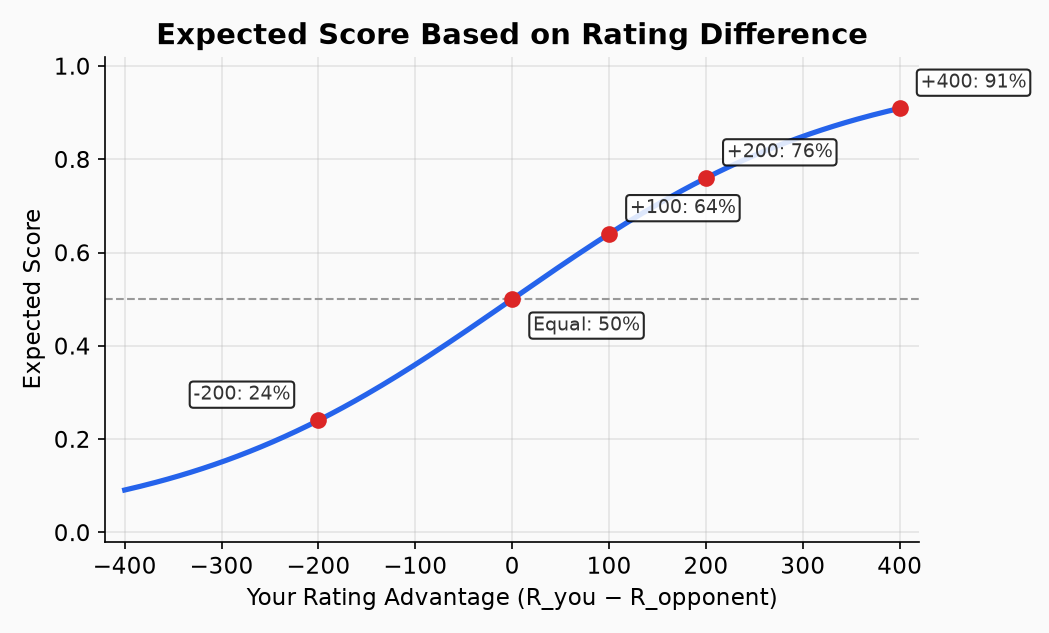
Alice vs Bob: E = 1 / (1 + 10^((1580-1650)/400)) = 0.60 Alice vs Carol: E = 1 / (1 + 10^((1520-1650)/400)) = 0.68 Alice vs Dave: E = 1 / (1 + 10^((1490-1650)/400)) = 0.72
Alice is expected to beat all three — she's the highest rated.
2. Actual Score — what did happen, with margin of victory:
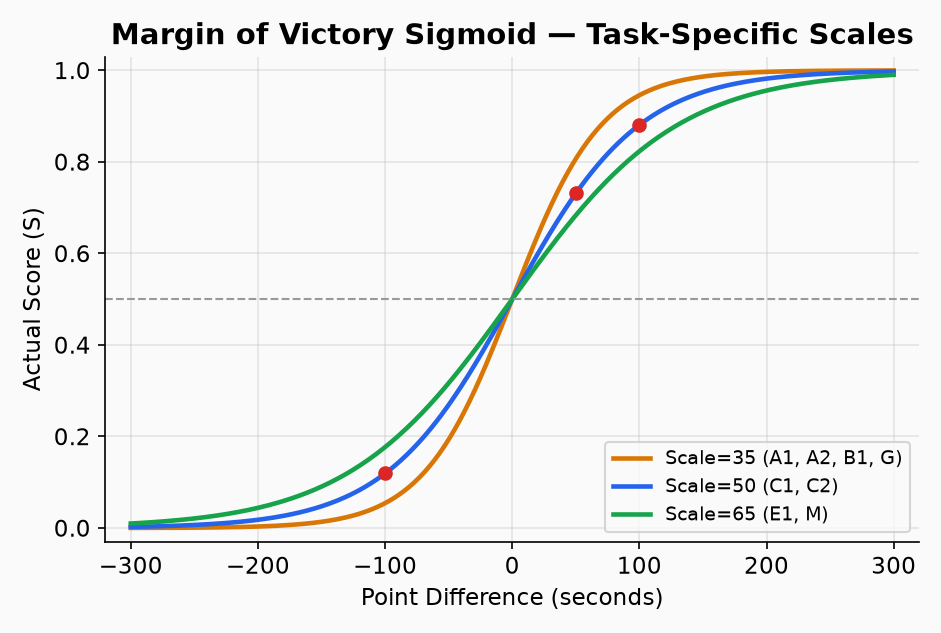
S = 1 / (1 + e^(-(your_points - their_points) / margin_scale))
The margin scale varies by task (see below). For Task B2 (scale=45):
Alice vs Bob (473 - 459 = +14): S = 0.58 (slight win) Alice vs Carol (473 - 439 = +34): S = 0.68 (solid win) Alice vs Dave (473 - 365 = +108): S = 0.92 (dominant win)
3. How Much Each Comparison Counts — the margin weight:
Two pilots who finish a second apart haven't really shown who's better. Each pairwise comparison is weighted by how much the two pilots actually separated, measured against the same task scale:
w = |your_points - their_points| / margin_scale (capped at 1.0, floored at 0.10)
Alice vs Bob (+14): w = 14/45 = 0.31 — close finish, counts less Alice vs Carol (+34): w = 34/45 = 0.76 — clear gap Alice vs Dave (+108): w = capped at 1.00 — decisive, counts fully
4. Rating Change:
delta = K × group_scale × (S_total - E_total) / sqrt(N - 1)
Where both totals are weighted sums, and group_scale = min(1.0, (N - 1) / 7). For this 4-pilot group: group_scale = 3/7 = 0.43.
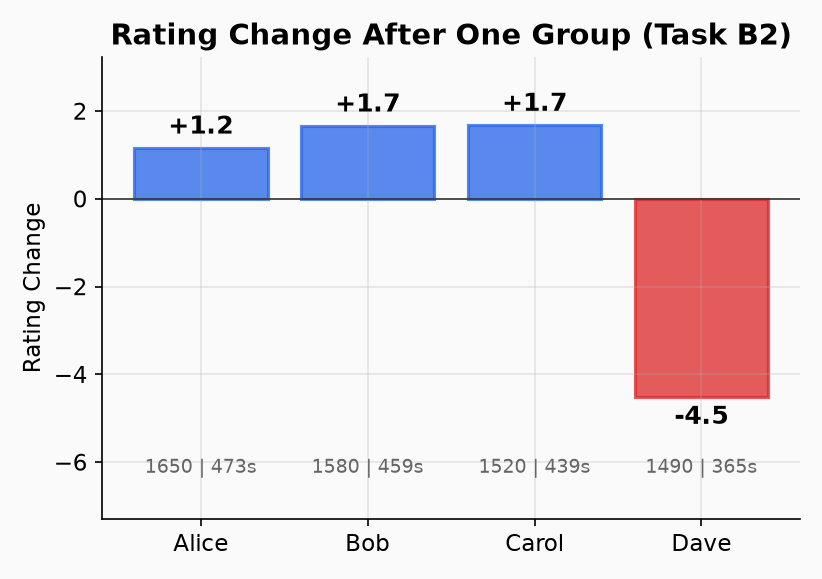
Alice's totals: S_total = 0.31×0.58 + 0.76×0.68 + 1.00×0.92 = 1.61 E_total = 0.31×0.60 + 0.76×0.68 + 1.00×0.72 = 1.41
delta = 24 × 0.43 × (1.61 - 1.41) / sqrt(3) = +1.2
Alice performed slightly better than expected — she gains 1.2 points. Her rating moves from 1650 to 1651.2. The small group size (4 pilots) reduces the impact compared to a full 8+ pilot group.
What about Dave?
Dave lost all three matchups, but the system considers how much he was expected to lose:
Dave vs Alice: E = 0.28, S = 0.08, w = 1.00 Dave vs Bob: E = 0.37, S = 0.11, w = 1.00 Dave vs Carol: E = 0.46, S = 0.16, w = 1.00
Every one of Dave's margins exceeded the task scale, so all three comparisons count at full weight — he separated unambiguously from the field, just in the wrong direction.
S_total = 0.36, E_total = 1.12
delta = 24 × 0.43 × (0.36 - 1.12) / 1.73 = -4.5
Dave loses 4.5 points. He was expected to lose, but he lost by larger margins than his rating predicted. In a full-size group (8+ pilots), the loss would be larger — but the small group size limits the impact.
Margin of Victory Matters
The system doesn't treat a win as just a win. Beating someone by 200 seconds counts more than beating them by 5 seconds.
The margin sigmoid converts point differences into scores between 0 and 1:
Task-Specific Margin Scales
Not all tasks have the same range of possible margins. In Task A2 (Last Flight, 7 min), most good pilots land within seconds of 5:00 — the ceiling is hard to exceed and easy to hit. In Task E1 (Poker), declared times create huge variance and margins of 60+ seconds are common.
A fixed scale would punish top pilots in ceiling-capped tasks: they'd be "expected" to win by margins that are physically impossible. The system accounts for this by using a task-specific margin scale that reflects how spread out scores naturally are for each task:
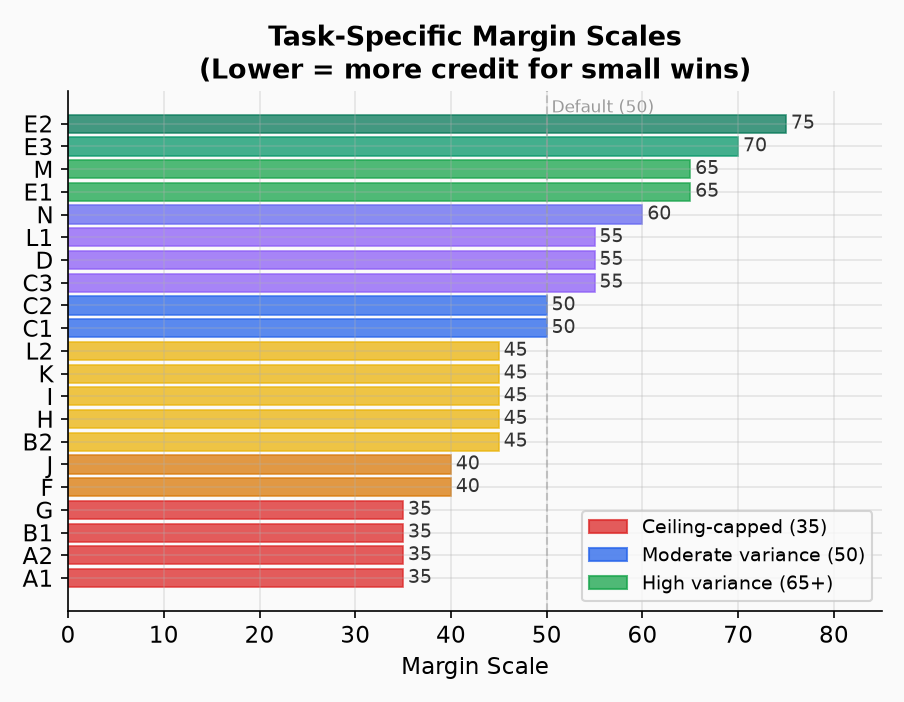
| Task Group | Margin Scale | Why |
|---|---|---|
| A1, A2, B1, G | 35 | Hard time ceiling — everyone near max, margins compressed |
| F, J | 40 | Short max flight time limits differentiation |
| B2, H, I, K, L2 | 45 | Moderate ceiling effects |
| C1, C2 | 50 | Multiple flights add variance |
| C3, D, L1 | 55 | Longer tasks with more room to differentiate |
| N | 60 | Single long flight — high risk/reward |
| E1, M | 65 | Poker / long working window — wide natural spread |
| E3 | 70 | Extended poker — even wider margins |
| E2 | 75 | Longest working window, maximum variance |
This means a 10-second win in Task G (2 min max, scale=35) generates the same ELO impact as a 19-second win in Task E1 (scale=65). Both represent "winning by a typical competitive margin for that task."
| Point Difference | Score (scale=35) | Score (scale=50) | Score (scale=65) |
|---|---|---|---|
| +5 | 0.57 | 0.55 | 0.54 |
| +15 | 0.65 | 0.57 | 0.56 |
| +30 | 0.70 | 0.65 | 0.61 |
| +50 | 0.81 | 0.73 | 0.68 |
| +100 | 0.95 | 0.88 | 0.82 |
This means maxing out a flight (landing exactly at the target time) matters — every second counts toward your rating. But it also means you won't be penalized for "only" winning by 10 seconds in a task where 10 seconds is a dominant margin.
The same scale drives the margin weight — how much each comparison counts at all:
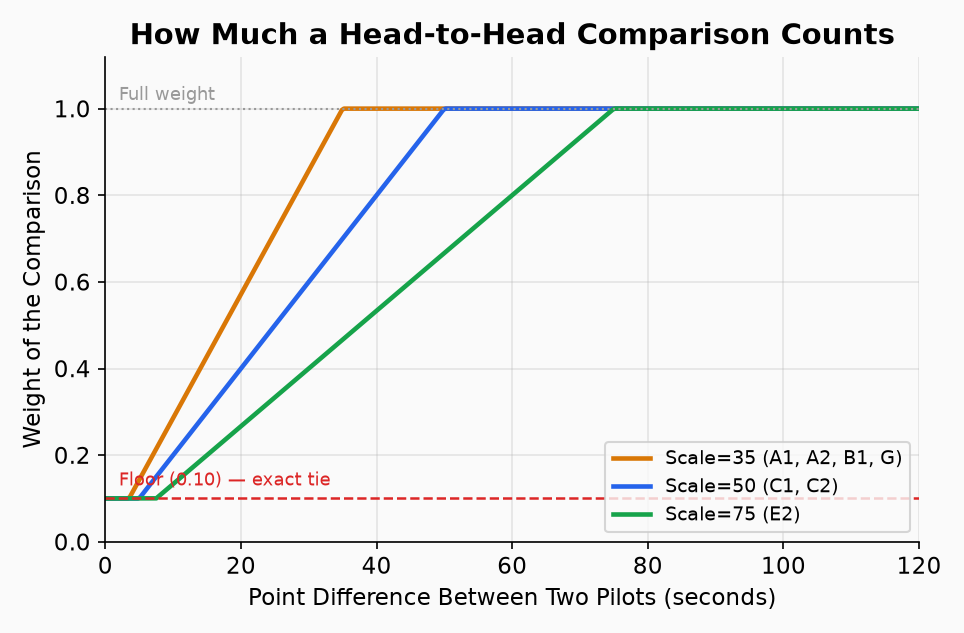
| Point Difference | Weight (scale=35) | Weight (scale=45) | Weight (scale=75) |
|---|---|---|---|
| 0 (exact tie) | 0.10 | 0.10 | 0.10 |
| +5 | 0.14 | 0.11 | 0.10 |
| +10 | 0.29 | 0.22 | 0.13 |
| +20 | 0.57 | 0.44 | 0.27 |
| +45 | 1.00 | 1.00 | 0.60 |
| +100 | 1.00 | 1.00 | 1.00 |
A 10-point gap is nearly three times as meaningful in Task A2 (scale 35) as in Task E2 (scale 75) — in the capped task it represents real separation, in the poker task it's noise. See Easy Rounds Count Less below.
Beating Stronger Pilots Rewards You More
The expected score is based on the rating gap between you and your opponent. When you beat someone rated much higher than you, your expected score was low — so the surprise factor is large.
Example: The Upset
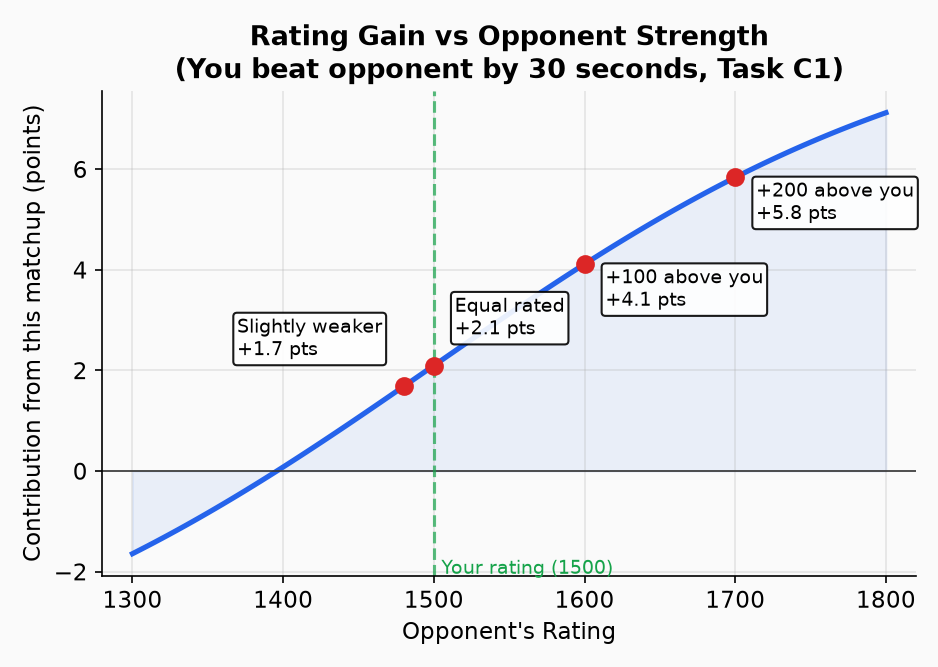
Scenario: A 1500-rated pilot beats a 1700-rated pilot by 30 seconds in Task C1 (scale=50).
Expected score against the 1700 pilot: E = 1 / (1 + 10^((1700-1500)/400)) = 0.24 Actual score (30-second margin): S = 1 / (1 + e^(-30/50)) = 0.65
Surprise = S - E = 0.65 - 0.24 = +0.41
Scenario: The same 1500-rated pilot beats a 1480-rated pilot by 30 seconds.
Expected score: E = 1 / (1 + 10^((1480-1500)/400)) = 0.53 Actual score: S = 0.65 (same margin, same score)
Surprise = 0.65 - 0.53 = +0.12
The same flight performance (winning by 30 seconds) generates 3.4x more rating gain when it's against a pilot rated 200 points above you versus one rated 20 points below you.
This is why competing in strong groups at major events is the fastest path to a high rating — and why dominating weak local fields produces only modest gains.
K-Factor: How Fast Ratings Move
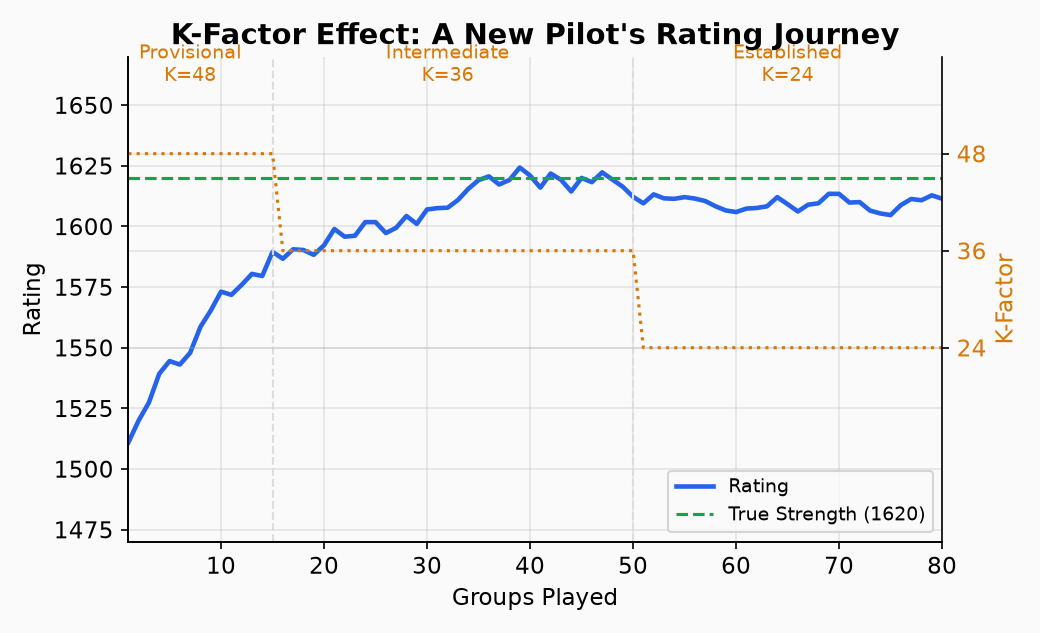
New pilots need their ratings to adjust quickly to find their true level. Established pilots should have more stable ratings. The K-factor controls this:
| Experience Level | Groups Played | K-Factor | Character |
|---|---|---|---|
| Provisional | 0–15 | 48 | Rating moves fast — finding your level |
| Intermediate | 16–50 | 36 | Settling in |
| Established | 51+ | 24 | Stable — only big performances shift it |
A provisional pilot gaining the same "surprise" as an established pilot will move their rating twice as fast (48/24 = 2x).
What this looks like in practice
A new pilot enters their first competition rated 1500. In a group of 8 with average rating 1550, they score well — finishing 2nd. Their K-factor of 48 might give them +15 points per round. After a 10-round competition, they could jump from 1500 to 1620.
An established pilot (200+ groups) in the same situation with K=24 would gain about +7 per round — moving from 1550 to 1620 over the same event.
Group Size Normalization
Groups range from 3 to 16 pilots. The system applies two layers of group-size adjustment:
1. Matchup normalization: The rating change is divided by sqrt(N-1) so that having more pairwise comparisons doesn't automatically create larger swings:
| Group Size | Normalization Factor | Effect |
|---|---|---|
| 3 pilots | sqrt(2) = 1.41 | Moderate per-group impact |
| 6 pilots | sqrt(5) = 2.24 | Slightly diluted per matchup |
| 10 pilots | sqrt(9) = 3.00 | Many matchups, each counts less |
| 16 pilots | sqrt(15) = 3.87 | Lots of information, gentle per-pair |
2. Small-group K-factor scaling: The K-factor is further scaled relative to a reference group size of 8 pilots. Groups smaller than 8 produce proportionally reduced rating changes:
effective_K = K × min(1.0, (N - 1) / 7)
| Group Size | Scale Factor | Effect |
|---|---|---|
| 3 pilots | 0.29 | ~70% reduction — minimal rating impact |
| 4 pilots | 0.43 | Significant reduction |
| 6 pilots | 0.71 | Moderate reduction |
| 8+ pilots | 1.00 | Full K-factor applied |
This prevents rating inflation from small local events where a strong pilot repeatedly beats 2–3 weak opponents across many rounds. Dominating a 4-pilot group over 15 rounds produces far less gain than performing well in a single round at a major competition with 12-pilot groups.
Inactivity Decay
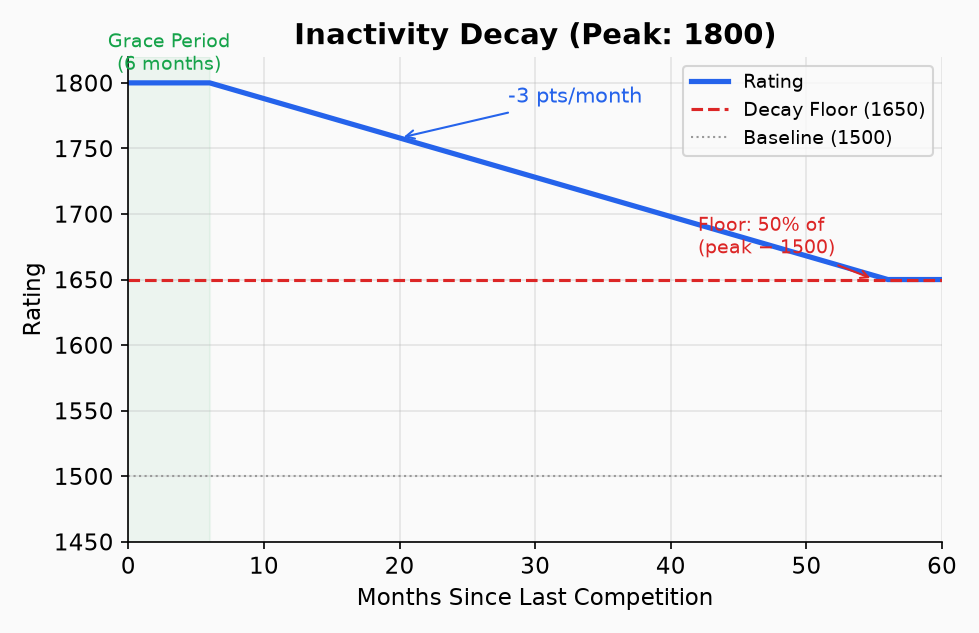
A rating should reflect current ability, not historical peak. If a pilot stops competing, their rating gradually decreases:
- Grace period: 6 months of inactivity before any decay begins
- Decay rate: 3 points per month after the grace period
- Floor: Rating cannot fall below 50% of the distance between 1500 and your peak
Decay Example
A pilot with a peak rating of 1800 stops competing:
Floor calculation:
floor = 1500 + (peak - 1500) × 0.5
     = 1500 + (1800 - 1500) × 0.5
     = 1650
After 6 months: no change (grace period) After 12 months: 1800 - (6 × 3) = 1782 After 18 months: 1800 - (12 × 3) = 1764 After 24 months: 1800 - (18 × 3) = 1746 After 56 months: would calculate to 1650 — hits floor, stops
The floor ensures that a pilot who was once world-class doesn't decay all the way to beginner level. Their history is acknowledged — but they still need to prove current form by competing.
Decay is Real, Not Cosmetic
When a pilot returns after a break, their rating has already been reduced. They re-enter the system at their decayed rating and must earn their way back up through results. This ensures the leaderboard always reflects who is performing well now.
Ranked vs Unranked
To appear as a ranked pilot on the leaderboard, you need:
- At least 30 group appearances (roughly 3–4 full competitions)
- At least 4 distinct competitions
Until these thresholds are met, a pilot has a rating (visible in their profile and history) but doesn't receive a numbered rank on the leaderboard. This prevents a single strong weekend from placing someone at #1.
Which Tasks Count Toward Your Rating
F3K's official task list has changed over the years — some formats were retired and replaced with newer ones. A task only counts toward your rating for as long as it was the sport's current official rule.
For example, the 5-flight version of the Poker task was F3K's official Poker format for over a decade, until it was replaced by a 3-flight version on January 1, 2020. Results flown before that date still count; results flown after don't, since by then the sport had moved on to a different rule. The same idea applies to a couple of older, now-retired task formats you may occasionally see in historical results.
You'll still see these tasks and their stats elsewhere on the site (look for a Historical badge on the Task Statistics page) — this only affects whether a given result factors into your rating.
Round Batching
Within a competition round, multiple groups fly simultaneously. The system processes all groups in a round using the same pre-round ratings, then applies all changes at once. This means:
- Group A and Group B in the same round don't influence each other's calculations
- Your round 3 performance is evaluated against ratings that include rounds 1 and 2
- No pilot gets an advantage from the order groups are processed
Reflights
Sometimes a pilot's attempt gets interrupted for reasons that aren't their fault — a rain delay that stops an entire group mid-flight, or a mistake by the contest organizers. F3K's rules let a pilot redo that attempt, and only one of the two results ever counts toward their rating, never both.
- If an entire group's flight was cancelled by weather and redone from scratch, the redo replaces the original — even if the original happened to score higher. The group's first attempt never happened, as far as the rules are concerned.
- If it was just one pilot's attempt that needed redoing, and they end up flying it in a different group to do so, we count whichever of their two results was better.
Either way, a pilot is never scored on the same round twice, and never punished twice for one bad flight.
Easy Rounds Count Less
Some rounds simply don't tell you who the better pilot is.
On an easy task, or on a calm day when the air is working everywhere, the whole group lands within a couple of seconds of the maximum. Everyone flew well. Nobody separated. A round like that contains almost no information about relative skill — and a rating system that treats it as a full result will move ratings on pure noise.
This is handled by the margin weight introduced earlier. Each pairwise comparison counts in proportion to how much the two pilots actually separated:
w = |point difference| / margin_scale (capped at 1.0, floored at 0.10)
Because the weight is applied to both the expected and the actual score, a near-tie shrinks its influence on the result rather than inventing an outcome.
There's no special rule for "easy rounds" — the behavior emerges. When the whole field bunches up, every pair in the group is a near-tie, so every weight is low and the round barely moves anyone.
The Same Four Pilots, Two Different Rounds
Round 1 — Task B2, scores spread out (473 / 459 / 439 / 365) — the same group from the worked example above. Real separation, weights 0.31 to 1.00:
| Pilot | Result | Rating change |
|---|---|---|
| Alice | 1st | +1.2 |
| Bob | 2nd | +1.7 |
| Carol | 3rd | +1.7 |
| Dave | 4th | −4.5 |
Round 2 — Task G, 2-minute ceiling, everyone maxes out (595 / 594 / 593 / 592). Same finishing order, but the entire group is inside 3 points. Every weight drops to the 0.10 floor:
| Pilot | Result | Rating change | (old system) |
|---|---|---|---|
| Alice | 1st | −0.3 | −2.7 |
| Bob | 2nd | −0.1 | −0.6 |
| Carol | 3rd | +0.1 | +1.2 |
| Dave | 4th | +0.2 | +2.0 |
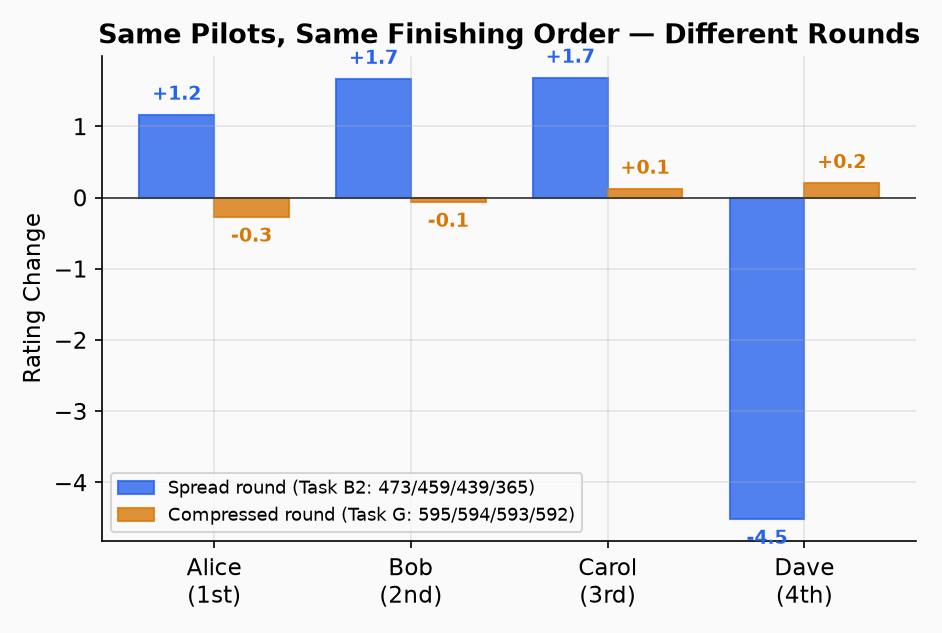
Alice won both rounds. In the compressed round the old system charged her −2.7 for it — she was the strongest pilot in the group, so the model expected her to win by a margin the task made physically impossible. Now that round costs her −0.3: still marginally negative (a near-tie against weaker pilots is mild evidence against you), but no longer a meaningful penalty for a round that proved nothing.
Why Not Just Ignore Ties?
An exact tie floors at 0.10 rather than dropping to zero, because tying a much weaker pilot is weak evidence — just very weak. Discarding those comparisons entirely would let a strong pilot bank an unlimited number of ceiling ties with no rating consequence at all.
It Cuts Both Ways
The mechanism is symmetric, and deliberately so. A lower-rated pilot who ties the field at the ceiling used to collect a substantial rating gain for it. They no longer do — matching everyone on a round nobody could lose isn't an upset.
Across the full history, average rating movement per round now scales with how much the round separated the field:
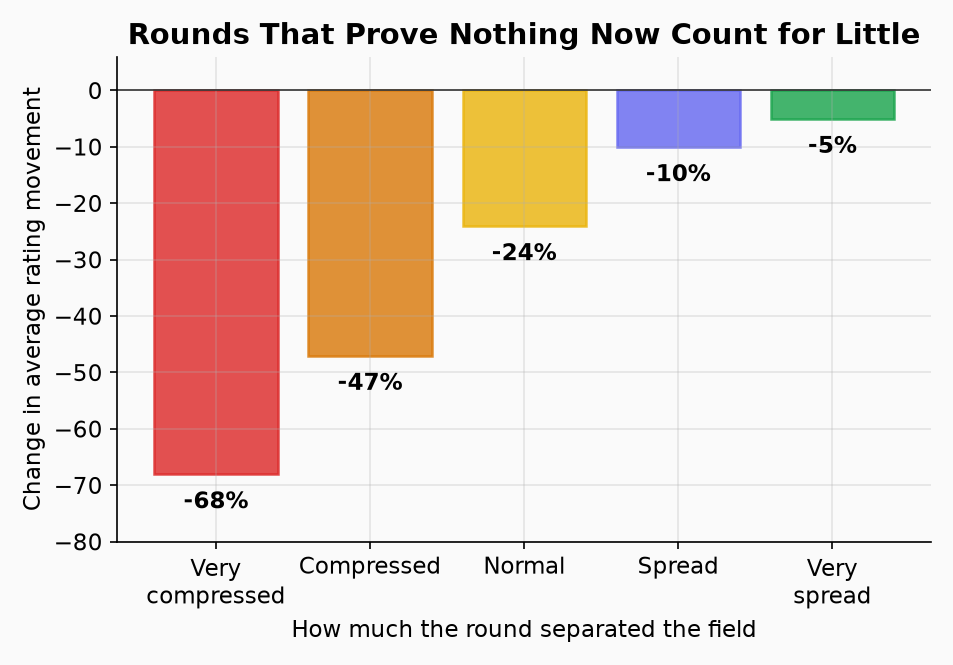
| How much the round separated the field | Change in rating movement |
|---|---|
| Very compressed — everyone within a fraction of the task's normal spread | −68% |
| Compressed | −47% |
| Normal | −24% |
| Spread out | −10% |
| Very spread out — a round that genuinely sorted the field | −5% |
Crucially, this is a redistribution, not a softening. Genuinely bad rounds now cost slightly more than before, because weight moves toward the rounds that actually discriminate. Blowing a high-variance task in front of a strong field is one of the most expensive things you can do to your rating.
Peak Rating
Every pilot has a peak rating — the highest rating they've ever achieved. This never decays. It represents the best form a pilot has shown and serves as a historical record, separate from the current (potentially decayed) rating.
Summary
| Mechanism | Purpose |
|---|---|
| Pairwise within groups | Fair comparison (same conditions) |
| Margin-aware scoring | Every second matters |
| Task-specific margin scales | Ceiling-capped tasks credit small wins fairly |
| Margin informativeness weight | Rounds that didn't separate the field count less |
| Expected vs actual | Upsets rewarded, beating weaker pilots less so |
| K-factor scaling | New pilots settle fast, veterans stay stable |
| Group size normalization | Consistent impact across group sizes; small groups produce less gain |
| Inactivity decay with floor | Reflects current form, respects history |
| Round batching | No processing-order advantage |
| Ranked thresholds | Proven track record required |
| Task eligibility by date | Retired task formats stop counting once they're no longer the official rule |
| Reflight resolution | One official result per round, never both |
The result: a single number that tells you how a pilot stacks up against the global F3K field right now — updated after every competition, grounded in head-to-head performance, and resistant to gaming through weak fields or cherry-picked events.